Franz Kafka Quotes
71 quotes • 5 books
Books by Franz Kafka
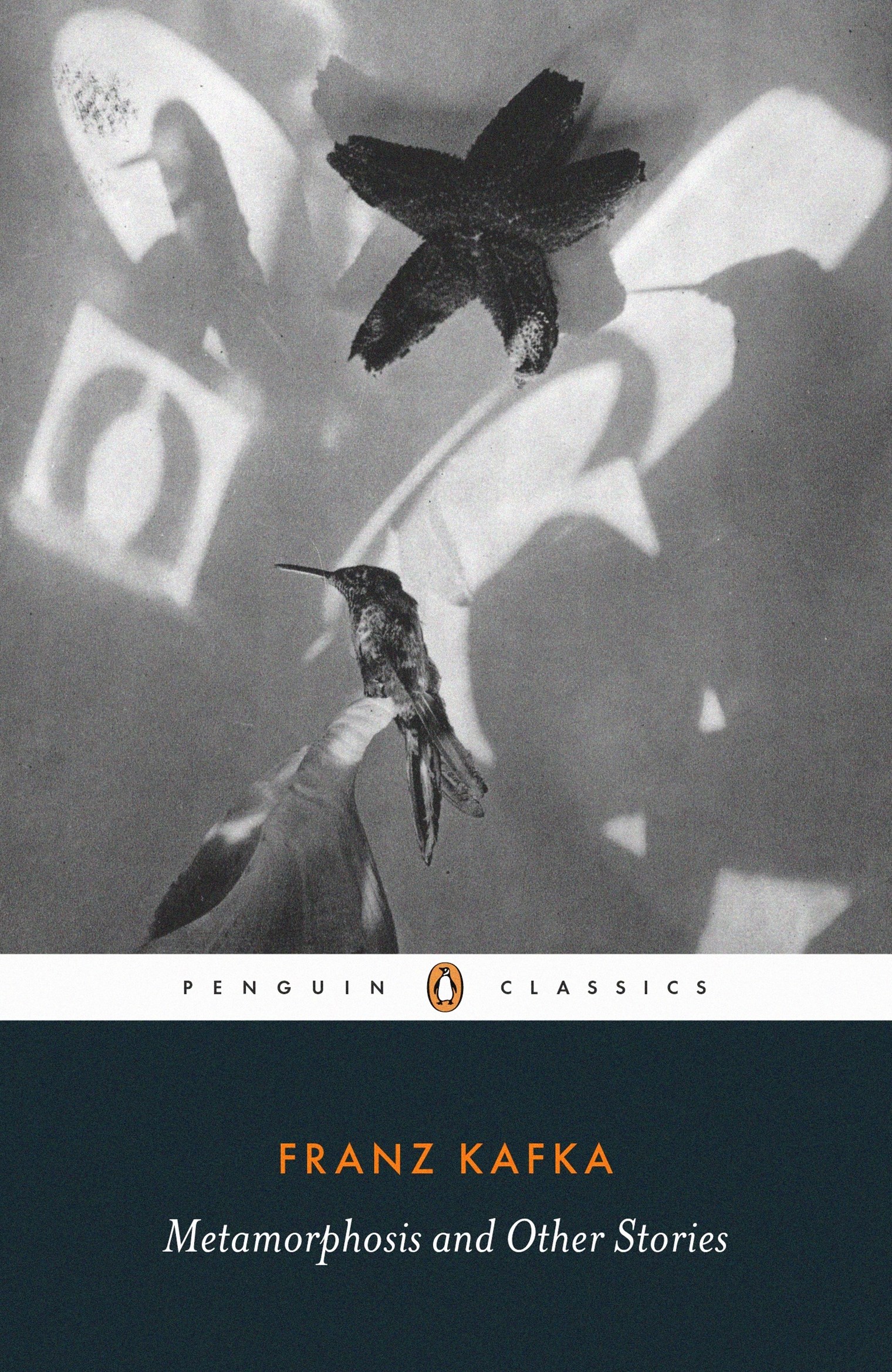


Metamorphosis and Other Stories (22)
“ "There was seldom any conversation, especially at first, that was not about him in some way, even if only in secret."”
“Now Gregor's sister also had to help his mother with the cooking; although that was not so much bother as no-one ate very much.”
“That was something his parents did not understand very well; over the years, they had become convinced that this job would provide for Gregor for his entire life...”
“Nothing would stop Gregor's father as he drove him back, making hissing noises at him like a wild man.”
“Gregor's appeals to his father were of no help, his appeals were simply not understood, however much he humbly turned his head his father merely stamped his foot all the harder.”
“One day, about a month after Gregor's transformation when his sister no longer had any particular reason to be shocked at his appearance, she came into the room a little earlier than usual and found him still staring out the window, motionless, and just where he would be most horrible.”
“Who, in this tired and overworked family, would have had time to give more attention to Gregor than was absolutely necessary?”
“I don't want to call this monster my brother, all I can say is: we have to try and get rid of it.”
“Gazing into the darkness, he felt a great pride that he was able to provide a life like that in such a nice home for his sister and parents.”
“Gregor converted his success at work straight into cash that he could lay on the table at home for the benefit of his astonished and delighted family.”
“So then he started working especially hard, with a fiery vigour that raised him from a junior salesman to a travelling representative almost overnight, bringing with it the chance to earn money in quite different ways.”
“For the time being he must remain calm, he must show patience and the greatest consideration so that his family could bear the unpleasantness that he, in his present condition, was forced to impose on them.”
“Whenever they began to talk of the need to earn money, Gregor would always first let go of the door and then throw himself onto the cool, leather sofa next to it, as he became quite hot with shame and regret.”
“For some reason, the tall, empty room where he was forced to remain made him feel uneasy as he lay there flat on the floor, even though he had been living in it for five years.”
“He seemed, unfortunately, to have no proper teeth - how was he, then, to grasp the key? - but the lack of teeth was, of course, made up for with a very strong jaw...”
“Gregor, despite his current sad and revolting form, was a family member who could not be treated as an enemy.”
“He lay on his armour-like back, and if he lifted his head a little he could see his brown belly, slightly domed and divided by arches into stiff sections.”
“The first thing he wanted to do was get the lower part of his body out of the bed, but he had never seen this lower part, and could not imagine what it looked like.”
“Of late, with his new habit of crawling about, he had neglected to pay attention to what was going on the rest of the flat the way he had done before.”
“But Gregor found it easy to give up having the door open, he had, after all, often failed to make use of it when it was open and, without the family having noticed it, lain in his room in its darkest corner.”
“One morning, when Gregor Samsa woke from troubled dreams, he found himself transformed in his bed into a horrible vermin.”
“Some of the time he passed in a light sleep, although he frequently woke from it in alarm because of his hunger, and some of the time was spent in worries and vague hopes...”
A Hunger Artist (16)
“Back then the hunger artist captured the attention of the entire city.”
““Because I couldn’t find a food which I enjoyed. If had found that, believe me, I would not have made a spectacle of myself and would have eaten to my heart’s content, like you and everyone else.” Those were his last words, but in his failing eyes there was the firm, if no longer proud, conviction that he was continuing to fast.” ”
““Experience had proven that for about forty days, through gradually intensified publicity, you could go on stimulating a city’s interest, but beyond that time there was no audience.” ”
““For he alone, and no other initiate, knew how easy it was to starve. It was the easiest thing in the world. He did not keep this fact a secret, but no one believed him.” ”
““He alone knew something that even initiates didn’t know how easy it was to fast.” ”
““He felt there were no limits to his capacity for fasting.” ”
““He was prepared to joke with them, to tell them stories from his journeyman years, and in turn to listen to their stories, anything just so as to keep them awake, to be able to show them again and again that he had nothing edible in the cage, and that he starved in a way that not one of them could.” ”
““If I had found the food I liked, believe me, I should have made no fuss and stuffed myself like you or anyone else.” These were his last words, but in his dimming eyes there remained the firm though no longer proud persuasion that he was still continuing to fast.” ”
““It was impossible to fight against this lack of understanding.” ”
““No one had any reason to be dissatisfied with what he had seen no one, that is, except for the starvation artist, he alone, always.” ”
““No one, not even the starvation artist himself knew how great his achievement really was, and his heart grew heavy.” ”
““Nothing was more excruciating to the hunger artist than such watchers. They depressed him.” ”
““The honour of his art forbade it.” ”
““The prospect of those visiting hours, for which the starvation artist naturally yearned, since they were the meaning of his life, also made him shudder.” ”
““This perversion of the truth, familiar to the artist though it was, always unnerved him afresh and proved too much for him. What was a consequence of the premature ending of his fast was here presented as the cause of it! To fight against this lack of understanding, against a whole world of nonunderstanding, was impossible.” ”
““Why did people want to rob him of the fame of fasting longer?” ”
Letters To Milena (15)
“I have spent all my life resisting the desire to end it.”
“It’s a little gloomy in Prague, I haven’t received any letters, my heart is a little heavy. Of course it’s impossible that a letter could be here already, but explain that to my heart.”
“That’s not the point, Milena, as far as I’m concerned you’re not a woman, you’re a girl, I’ve never seen anyone who was more of a girl than you, and girl that you are, I don’t dare offer you my hand, my dirty, twitching, clawlike, fidgety, unsteady, hot-cold hand.”
““All writing seems futile to me, and it really is. The best would probably be for me to go to Vienna and take you away; I may even do it, although you don’t want me to.” (9 July 1920)”
““I wanted to excel in your eyes, show my strength of will, wait before writing you, first finish a document, but the room is empty, no one is minding me – it’s as if someone said: leave him alone, can’t you see how engrossed he is in his own affairs, it’s as if he had a fist in his mouth. So I only wrote half a page and am once again with you, lying on this letter like I lay next to you back then in the forest.” (16 July 1920)”
““With my teeth clenched, however, and with your eyes before me I can endure anything: distance, anxiety, worry, letterlessness.” (16 July 1920)”
““I am caught in a tide of sorrow and love which is carrying me away from writing.” (17 July 1920)”
“This one is particularly beautiful and profound, straight from the heart. When I first read it, I loved the fact that he needs solitude and time to think about Milena, but then when I read it the second time, something else struck me: when he says his office job is boring, his flat is stupid, but he feels he must not complain about his everyday reality because Milena is part of it too, and the gratefulness he feels for that: this moment which belongs to you:”
““A slight blow for me: a telegram from Paris, informing me that an old uncle of mine (…) is arriving tomorrow evening. It is a blow because it will take time and I need all the time I have and a thousand times more than all the time I have and most of all I’d like to have all the time there is just for you, for thinking about you, for breathing in you. My apartment is making me restless, the evenings are making me restless, I’d like to be someplace different and I’d prefer it if the office didn’t exist at all; but then I think that I deserve to be hit in the face for speaking beyond the present moment, this moment, which belongs to you.” (6 July 1920)”
““…and I am here just like I was in Vienna and your hand is in my own as long as you leave it there.” (29th July 1920)”
““You’re always wanting to know, Milena, if I love you, but after all, that’s a difficult question which cannot be answered in a letter (not even in last Sunday’s letter). I’ll be sure to tell you the next time we see each other (if my voice doesn’t fail me.” (30 July 1920)”
““Milena among the saviors! Milena who is constantly discovering in herself that the only way to save another person is by being there and nothing else. Moreover, she has already saved me once with her presence and now, after the fact, is trying to do so with other, infinitely smaller means. Naturally, saving someone from drowning is a great deed, but what good is it if the savior then sends the saved a gift-certificate for a swimming course?” (31 July 1920)”
““And how can I fly if we are holding hands? And what good is it for us to both fly away? And besides – this is actually the main thought of the above – I’ll never go so far away from you again.” (31 July 1920)”
““I am dirty, Milena, endlessly dirty, that is why I make such a fuss about cleanliness. None sing as purely as those in deepest hell; it is their singing we take for the singing of angels.” (26 August 1920)”
““Why, Milena, do you write about our common future which will never be, or is it that why you write about it? (…) Few things are certain, but one is that we’ll never live together, share an apartment, body to body, at a common table, never, not even in the same city. (…) Incidentally, Milena, you must agree when you examine yourself and me and take soundings of the “sea” between “Vienna” and “Prague” with its insurmountably high waves.” (Prague, September 1920)”
The Trial (11)
“Someone must have been telling lies about Joseph K., for without having done anything wrong he was arrested one fine morning. His landlady's cook, who always brought him his breakfast at eight o'clock, failed to appear on this occasion. That had never happened before.”
“Variant translation: Somebody must have slandered Joseph K., for without having done anything wrong he was arrested one fine morning.”
“It would have been so pointless to kill himself that, even if he had wanted to, the pointlessness would have made him unable.”
“They're talking about things of which they don't have the slightest understanding, anyway. It's only because of their stupidity that they're able to be so sure of themselves.”
“This question of yours, Sir, about my being a house painter — or rather, not a question, you simply made a statement — is typical of the whole character of this trial that is being foisted on me. You may object that it is not a trial at all; you are quite right, for it is only a trial if I recognize it as such. But for the moment I do recognize it, on grounds of compassion, as it were. One can't regard it except with compassion, if one is to regard it at all. I do not say that your procedure is contemptible, but I should like to present that epithet to you for your private consumption.”
“Variant translation: Your question, Mr. Examining Magistrate, as to whether I am a house-painter — although you did not ask a question at all, you made a statement — typifies exactly the kind of proceedings that are being instituted against me.”
“The right understanding of any matter and a misunderstanding of the same matter do not wholly exclude each other.”
“What an obstacle had suddenly arisen to block K.'s career! And this was the moment when he was supposed to work for the bank? He looked down at his desk. This the time to interview clients and negotiate with them? While his case was unfolding itself, while up in the attics the Court officials were poring over the charge papers, was he to devote his attention to the affairs of the bank? It looked like a kind of torture sanctioned by the Court, arising from his case and concomitant with it.”
“Even that has its reason; it is often better to be in chains than to be free.”
“'...it is not necessary to accept everything as true, one must only accept it as necessary.' 'A melancholy conclusion,' said K. 'It turns lying into a universal principle.In the Cathedral”
“Logic may indeed be unshakeable, but it cannot withstand a man who is determined to live. Where was the judge he had never seen? Where was the High Court he had never reached? He raised his hands and spread out all his fingers. But the hands of one of the men closed round his throat, just as the other drove the knife deep into his heart and turned it twice.”
The Castle (7)
“No matter how much you keep encouraging someone who is blindfolded to stare through the cloth, he still won't see a thing.".”
“If a man has his eyes bound, you can encourage him as much as you like to stare through the bandage, but he'll never see anything”
“This village belongs to the Castle, and whoever lives here or passes the night here does so in a manner of speaking in the Castle itself. Nobody may do that without the Count's permission.”
“There's no quiet place here on earth for our love, not in the village and not anywhere else, so I picture a grave, deep and narrow, in which we embrace as if clamped together, I bury my face against you, you yours against me, and no one will ever see us.”
“One must fight to get to the top, especially if one starts at the bottom.”
“I dream of a grave, deep and narrow, where we could clasp each other in our arms as with clamps, and I would hide my face in you and you would hide your face in me, and nobody would ever see us any more”
“Officials are highly educated but one-sided; in his own department an official can grasp whole trains of thought from a single word, but let him have something from another department explained to him... he won't understand a word of it.”