Jared Diamond Quotes
65 quotes • 3 books
Books by Jared Diamond
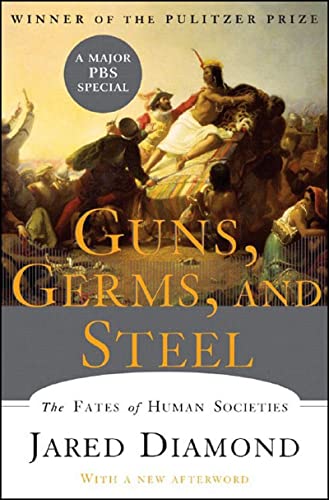
Guns, Germs And Steel (40)
“ Why is that you white people developed so much cargo ... but we black people had little cargo? ”
“ Literacy made the Spaniards heirs to a huge body of knowledge about human behavior and history. ”
“ The resulting food surpluses ... were a prerequisite for the development of ... innovative societies. ”
“ I am unaware of anyone ... seriously suggesting ... biological features of the region's peoples that might have contributed. ”
“ Happy families are all alike; every unhappy family is unhappy in its own way. ”
“ Only a small percentage of wild mammal species ended up in happy marriages with humans. ”
“ No waves of native grain ever stretched from the Atlantic to the Pacific coast of North America. ”
“ Food production, and competition and diffusion between societies, led as ultimate causes ... of conquest. ”
“ Thanks to the achievements of East Asia's first farmers, China became Chinese. ”
“ Europe's colonization of Africa had nothing to do with differences between European and African peoples. ”
“ If ... Australia and Eurasia could have been interchanged ... Eurasians would be ... reduced to ... fragments. ”
“ The challenge now is to develop human history as a science. ”
“Much of human history has consisted of unequal conflicts between the haves and the have-nots.”
“With the rise of chiefdoms around 7,500 years ago, people had to learn, for the first time in history, how to encounter strangers regularly without attempting to kill them.”
“It's striking that Native Americans evolved no devastating epidemic diseases to give to Europeans in return for the many devastating epidemic diseases that Indians received from the Old World.”
“My two main conclusions are that technology develops cumulatively, rather than in isolated heroic acts, and that it finds most of its uses after it has been invented, rather than being invented to meet a foreseen need.”
“Not until the beginning of the 20th century did Europe's urban populations finally become self-sustaining: before then, constant immigration of healthy peasants from the countryside was necessary to make up for the constant deaths of city dwellers from crowd diseases.”
“Rhino-mounted Bantu shock troops could have overthrown the Roman Empire. It never happened.”
“All human societies contain inventive people. It’s just that some environments provide more starting materials, and more favorable conditions for utilizing inventions, than do other environments.”
“One way to explain the complexity and unpredictability of historical systems, despite their ultimate determinacy, is to note that long chains of causation may separate final effects from ultimate causes lying outside the domain of that field of science.”
“Tolstoy meant that, in order to be happy, a marriage must succeed in many different respects: sexual attraction, agreement about money, child discipline, religion, in-laws, and other vital issues.”
“It invites a search for ultimate causes: why were Europeans, rather than Africans or Native Americans, the ones to end up with guns, the nastiest germs, and steel?”
“In contrast, once food can be stockpiled, a political elite can gain control of food produced by others, assert the right of taxation, escape the need to feed itself, and engage full-time in political activities.”
“Despite being depicted in innumerable cartoons as apelike brutes living in caves, Neanderthals had brains slightly larger than our own. They were also the first humans to leave behind strong evidence of burying their dead and caring for their sick.”
“The whole modern world has been shaped by lopsided outcomes.”
“Yes, world history is indeed such an onion!”
“Food production was indirectly a prerequisite for the development of guns, germs, and steel. Hence geographic variation in whether, or when, the peoples of different continents became farmers and herders explains to a large extent their subsequent contrasting fates.”
“A suitable starting point from which to compare historical developments on the different continents is around 11,000 B.C.”
“Thus, Fertile Crescent and eastern Mediterranean societies had the misfortune to arise in an ecologically fragile environment. They committed ecological suicide by destroying their own resource base.”
“People with blood group B or O have a greater resistance to smallpox than do people with blood group A.”
“Nearly half of all New Guinea languages have fewer than 500 speakers.”
“African and European skulls of half a million years ago were sufficiently similar to skulls of us moderns that they are classified in our species, Homo sapiens, instead.”
“Naturally, what makes patriotic and religious fanatics such dangerous opponents is not the deaths of the fanatics themselves, but their willingness to accept the deaths of a fraction of their number in order to annihilate or crush their infidel enemy.”
“Despite being depicted in innumerable cartoons as apelike brutes living in caves, Neanderthals had brains slightly larger than our own.”
“Almost all studies of child development emphasize the role of childhood stimulation and activity in promoting mental development, and stress the irreversible mental stunting associated with reduced childhood stimulation.”
“Before the spread of alphabetic writing, systems making much use of logograms were more common and included Egyptian hieroglyphs, Maya glyphs, and Sumerian cuneiform.”
“Why, within Eurasia, were European societies, rather than those of the Fertile Crescent or China or India, the ones that colonized America and Australia, took the lead in technology, and became politically and economically dominant in the modern world?”
“As we shall see, the prerequisites for those developments consisted of several features of human society that determined whether a society would find writing useful, and whether the society could support the necessary specialist scribes.”
“Because diseases have been the biggest killers of people, they have also been decisive shapers of history. Until World War II, more victims of war died of war-borne microbes than of battle wounds.”
“The anthropologist Claude Lévi-Strauss put it, ancient writing’s main function was to facilitate the enslavement of other human beings.”
Collapse: How Societies Choose to Fail or Succeed (17)
“History, as well as life itself, is complicated; neither life nor history is an enterprise for those who seek simplicity and consistency.”
“People often ask, "What is the single most important environmental/population problem facing the world today?" A flip answer would be, "The single most important problem is our misguided focus on identifying the single most important problem!"”
“Two types of choices seem to me to have been crucial in tipping their outcomes towards success or failure: long-term planning, and willingness to reconsider core values. On reflection, we can also recognize the crucial role of these same two choices for the outcomes of our individual lives.”
“On the fates of past societies facing problems of sustainability.”
“[..] the values to which people cling most stubbornly under inappropriate conditions are those values that were previously the source of their greatest triumphs.”
“Religious values tend to be especially deeply held and hence frequent cause of disastrous behaviour. [...] The modern world provides us with abundant secular examples of admirable values to which we cling under conditions where those values no longer make sense [...] It appears to me that much of the rigid opposition to environmental concerns in the First World nowadays involves values acquired early in life and never again reexamined [...].”
“My views may seem to ignore a moral imperative that businesses should follow virtuous principles, whether or not it is most profitable for them to do so. Instead I prefer to recognize that, throughout human history, [...] government regulation has arisen precisely because it was found to be necessary for the enforcement of moral principles. Invocation of moral principles is a necessary first step for eliciting virtuous behavior, but that alone is not a sufficient step.”
“Businesses have changed when the public came to expect and require different behavior, to reward businesses for behavior that the public wanted, and to make things difficult for businesses practising behaviors that the public didn't want. I predict that in the future, just as in the past, changes in public attitudes will be essential for changes in businesses' environmental practices.”
“Those numbers may not sound like a big deal until one reflects that average global temperatures were "only" 5 degrees cooler at the height of the last Ice Age.”
“Thus, because we are rapidly advancing along this non-sustainable course, the world's environmental problems will get resolved, in one way or another, within the lifetimes of the children and young adults alive today The only question is whether they will become resolved in pleasant ways of our own choice, or in unpleasant ways not of our choice, such as warfare, genocide, starvation, disease epidemics, and collapses of societies. While all of those grim phenomena have been endemic to humanity throughout our history, their frequency increases with environmental degradation, population pressure, and the resulting poverty and political instability.”
“"The environment has to be balanced against the economy." This quote portrays environmental concerns as a luxury, views measures to solve environmental problems as incurring a net cost, and considers leaving environmental problems unsolved to be a money-saving device. This one-liner puts the truth exactly backwards. Environmental messes cost us huge sums of money both in the short run and in the long run; cleaning up or preventing those messes saves us huge sums in the long run, and often in the short run as well. In caring for the health of our surroundings, just as of our bodies, it is cheaper and preferable to avoid getting sick than to try to cure illnesses after they have developed.”
“In fact, one of the main lesson to be learned from the collapses of the Maya, Anasazi, Easter Islanders, and those other past societies (as well as from the recent collapse of the Soviet Union) is that a society's steep decline may begin only a decade or two after the society reaches its peak numbers, wealth, and power. [...] The reason is simple: maximum population, wealth, resource consumption, and waste production mean maximum environmental impact, approaching the limit where impact outstrips resources. On reflection, it's no surprise that declines of societies tend to follow swiftly on their peaks.”
“If the Easter Islanders couldn't solve their milder local problems in the past, how can the modern world hope to solve its big global problems? People who get depressed at such thoughts often then ask me, “Jared, are you optimistic or pessimistic about the world’s future?” I answer, “I am a cautious optimist.” By that, I mean that, on the one hand, I acknowledge the seriousness of the problems facing us. If we don’t make a determined effort to solve them, and if we don’t succeed at that effort, the world as a whole within the next few decades will face a declining standard of living, or perhaps something worse. That’s the reason why I decided to devote most of my career efforts at this stage of my life to convincing people that our problems have to be taken seriously and won’t go away otherwise. On the other hand, we shall be able to solve our problems – if we choose to do so.”
“Because we are the cause of our environmental problems, we are the ones in control of them, and we can choose or not choose to stop causing them and start solving them. The future is up for grabs, lying in our own hands. We don’t need new technologies to solve our problems; while new technologies can make some contribution, for the most part we "just" need the political will to apply solutions already available.”
“What are the choices that we must make if we are now to succeed, and not to fail? [...] Two types of choices seem to me to have been crucial to tipping their outcomes towards success or failure: long-term planning, and willingness to reconsider core values. On reflection, we can also recognize the crucial role of these same two choices for the outcomes of our individual lives. One of those choices has depended on the courage to practice long-term thinking, and to make bold, courageous, anticipatory decisions at a time when problems have become perceptible but before they have reached crisis proportions. [...] The other crucial choice illuminated by the past involves the courage to make painful decisions about values. Which of the values that formerly served a society well can continue to be maintained under new changed circumstances? Which of these treasured values must instead be jettisoned and replaced with different approaches?”
“Remember that impact is the product of two factors: population multiplied times impact per person.”
“My hope in writing this book has been that enough people will choose to profit from that opportunity to make a difference.”
Why Is Sex Fun?: The Evolution of Human Sexuality (8)
“How can we explain simultaneously this general pattern of female parental care and also its numerous exceptions?”
“The answer comes from the realization that genes for behavior, as well as for malaria resistance and teeth, are subject to natural selection.”
“In particular, while natural selection favors both males and females that leave many offspring, the best strategy for doing so may be different for fathers and mothers. That generates a built-in conflict between the parents, a conclusion that all too many humans don’t need scientists to reveal to them. We make jokes about the battle of the sexes, but the battle is neither a joke nor an aberrant accident of how individual fathers or mothers behave on particular occasions. It is indeed perfectly true that behavior that is in a male’s genetic interests may not necessarily be in the interests of his female co-parent, and vice versa. That cruel fact is one of the fundamental causes of human misery.”
“Though seemingly remote from human sexuality, shorebird sexuality is instructive because it illustrates the main message of this book: a species’ sexuality is molded by other aspects of the species’ biology. It’s easier for us to acknowledge this conclusion about shorebirds, to which we don’t apply moral standards, than about ourselves.”
“Our sex is ultimately laid down by our genes.”
“Perhaps our greatest distinction as a species is our capacity, unique among animals, to make counter-evolutionary choices.”
“Behavior evolves through natural selection, just as anatomy does. Hence if sex is enjoyable, natural selection must have been responsible for that outcome.”
“Physiologists and molecular biologists regularly fall into the trap of overlooking this distinction, which is fundamental to biology, history, and human behavior. Physiology and molecular biology can do no more than identify proximate mechanisms; only evolutionary biology can provide ultimate causal explanations.”